Tideswell is a large, ancient village situated in Derbyshire and the Peak District, 6 miles east of Buxton, off the B6049, in a wide dry valley on a limestone plateau, at an altitude of over 1000ft.
Tideswell dates back earlier than Roman times and at Domesday it was part of the enormous parish of Hope but in 1207 it was granted to Thomas Armiger and in 1251, a market charter. Tideswell became a thriving market town selling local produce, and held 5 important fairs a year. The village also became a principal market for wool and lead and rapidly grew in prosperity and population.
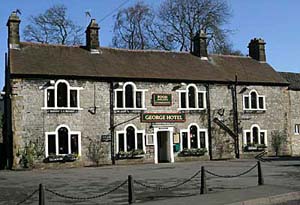
Tideswell |
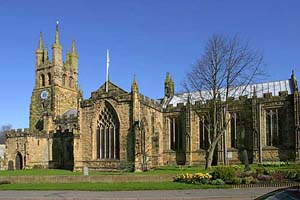
Tideswell |
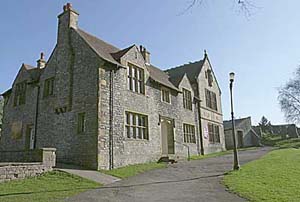
Tideswell |
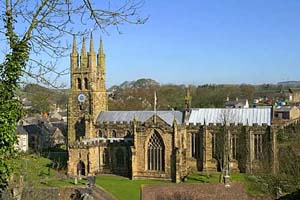
Tideswell |
Tideswell markets are no more, but the towns prosperity at the time is reflected by its magnificent church, dedicated to St John the Baptist and often referred to as the Cathedral of the Peak, which was started and completed in the 14th century. It a cruciform building in Decorated style with a Perp, pinnacled tower built later. It stands as a land mark for miles around and has remained relatively unaltered since. The high aisled and clerestoried nave is linked to the tower by a great arch and its beautifully proportioned unaisled chancel has tall traceried windows of clear glass, giving rise to a description of it as ' one gallery of light and beauty'.
The builder of the church was probably Sir John Foljambe, of a prominent local landowning family, whose brass is in the sanctuary. Another splendid brass is of the Bishop Robert Pursglove, a Tideswell man and benefactor of the village, who founded the grammer school in 1569. THe school was closed in 1927. Many of the wooden carvings in the church are by the Hunstone family, woodcarvers of repute for 3 generations. Buried here is William Newton, the utilitarian manager of Cressbrook Mill and a poet, known as the Minstrel of the Peak.
The textile industry came into prominance here in the 19th century when the nearby mills of Cressbrook and Litton were producing cotton and small factories at Tideswell itself were involved in te hand weaving of silk scarves and handkerchiefs for the Macclesfield silk industry.
Tideswell Dale, which leads down to Litton Mill, is a Derbyshire Wildlife Nature Reserve, noted for some beautiful are flowers. Notable outcrops of 'toadstones' - a blue green basalt created by ancient volcanic activity - are to be found in the dale. Tideswell makes an ideal base for walking and climbing, with water sports within easy reach. It is well known for its annual Well Dressing, which starts on the Saturday nearest to the 24th June, this being John the Baptist day, and continues for a week with carnivals, parades and fun for the whole family.
The Tideswell community has protected and preserved all aspects of its rural heritage. It won the Derbyshire best kept village award in 1999, and also won the Eat Midlands Region Britain in bloom contest in 1994, 1995 and in 1997. Locals know the village as 'Tidza' , a vernacular corruption of its full name. They themselves are known as 'Sawyeds', after a traditional story about a farmer whose cow got its head stuck in a gate. Legend has it that the farmer freed the beat by sawing off its head.
The village has a long theatrical tradition, Tideswell Theatre having been formed over 200 years ago to perform leading plays of the time. It was revived in 2002 to bring quality professional theatre, music, dance and comedy to the area. Tideswell Community Players are one of the oldest drama groups in the country, formed in 1929. Until the 1960s the village also had its own cinema, The Picturehouse. Tideswell Cinema was revived in 2005 to bring film once more to the community, with screenings for three seasons at Bishop Pursglove School's hall, before relocating in 2008 to the upper storey of The George Hotel.
Despite its population of only 1,800, Tideswell still has that magic triumvirate: a butcher, baker, and a greengrocer, plus an ice-cream parlour, café, takeaway-lunch shop, four pubs, two fish-and-chip shops, and a Co-op. Food is not in short supply here. It's a real living village, not an artificial chocolate-box setting. By keeping the rural shops open for local people, Tideswell is preserving the reality of a working village in the Peak District. Taste Tideswell is part of the Village SOS scheme from the Big Lottery Fund. It gave out six awards to deserving schemes across the country, the results of which were broadcast on the BBC. The biggest financial aspect of Tideswell's scheme has been the creation of a cookery school, commercial kitchen and nano-brewery, offering food-and-drink courses to visitors.
For food and drink in Tideswell please see Places to eat and drink in Tideswell
Tideswell's top tastes
Peaches Greengrocer: Gets a fresh fruit and veg delivery every day, and sells locally grown produce. Some more unusual items such as kohlrabi.
Peak District Dairy: Ice-cream parlour, farm shop, and café. Robert Walker's award-winning ice cream is made from his local dairy herd's milk. Choose from one of the day's 12 flavours.
Vanilla Kitchen: The triple chocolate brownie here won a Gold Taste award. Popular café, opens five days a week and does breakfast, lunch, coffee and cake. The owner, Louise Sharpe, uses local ingredients whenever she can.
NT Gibbs butcher: Run by Philip Gibbs, whose father, Norman, took it over in 1958. Meat sourced locally where possible. The black pudding won a national food award.
Cherry Tree: Takeaway lunch place. Owners Barbara and David Cooper daily make batches of tray-bakes which are delivered around the county. Local workers come in for takeaway sandwiches and salad boxes.
Tindalls Bakery & Delicatessen: A great place. The family owners are up in the small hours making pies, puddings, pasties and breads. Check out the "Tidza pud", fidgety pasty, and owner Carol Cox's award-winning flavoured cooking sugars and salts.
Parking and public toilets are available in the village
Holiday Accommodation in Tideswell
Self Catering Cottages and B&B Guest House Accommodation in Tideswell
Merman Farm Holiday Cottage - Merman Farm Holiday Cottage is a traditional, stone built former farmhouse situated in a quiet location, a few minutes' walk from the centre of the village of Tideswell, one of the oldest settlements in the central Peak District.
Fully restored by the owner, Merman Farm offers quality accommodation of real character and charm and seamlessly combines many original features with modern design and home comforts. Sleeping up to 11 in 5 bedrooms, 3 ensuite, open fire and pet friendly. Read more at Merman Farm Holiday Cottage
Rockingham Lodge B&B - Nick & Gill Brelsford welcome you to Rockingham Lodge, an Eighteenth Century former Inn, ideally located for walkers or cyclists.
All of our three rooms have flat screen televisions and tea and coffee making faciltities and there is a large guest lounge available at all times for the use of guests with a wood burning stove for those colder winter nights.
Read more at Rockingham Lodge Bed & Breakfast
